August 26, 2026

ISO-9001-Lead-Auditor Dumps – Grab Out For [NEW-2026] PECB Exam [Q17-Q36]

Rate this post

ISO-9001-Lead-Auditor Dumps – Grab Out For [NEW-2026] PECB Exam

ISO-9001-Lead-Auditor Exam Dumps PDF Guaranteed Success with Accurate & Updated Questions

Q17. An audit team of three people is conducting a Stage 2 audit to ISO 9001 of an engineering organisation that manufactures sacrificial anodes for the oll and gas industry in marine environments. These are aluminium products designed to prevent corrosion of submerged steel structures. You, as one of the auditors, find that the organisation has shipped anodes for Project DK in the Gulf of Mexico before the galvanic efficiency test results for the anodes have been fully analysed and reported as required by the customer. The Quality Manager explains that the Managing Director authorised release of the anodes to avoid late delivery as penalties would be imposed. The customer was not informed since the tests very rarely fall below the required efficiency. You raise a nonconformity against clause 8.6 of ISO 9001.
Which of the following options for the best description of the nonconformity?


Q18. You are auditing a manufacturer of specialty tea products during a Stage 2 certification audit. In the quality laboratory, you interview one of three operatives conducting sensory testing of a batch from the production line.
Select three options of evidence which could demonstrate conformance with clause 9.1.1 of ISO 9001:
2015.


Q19. Which two of the following may be changed once a Stage 2 certification audit has commenced?


Q20. You are conducting a third-party Stage 1 audit at ABC Ltd, a single-site organisation that manufactures wooden furniture. You interview the Technical Director to learn more about the organisation. The Technical Director explains that they have had a successful year and that obtaining ISO 9001 certification will support the further growth of the business. You ask for an overview of the organisation’s structure and its interrelationships with external interested parties.
The Technical Director shows you a document detailing all business processes and interrelationships. You notice in this document that another organisation called Teak Ltd manufactures wooden furniture on behalf of ABC Ltd. The Technical Director confirms this capability has been accounted for in the scope of the quality management system. You learn that the furniture manufactured by Teak Ltd has accounted for 40% of the sales revenue over the previous 12 months.
Which two of the following options best describe how you would plan the audit of the interrelationship with Teak Ltd during the Stage 2 audit at ABC Ltd?


Q21. Which of the following three options could be considered potential threats to impartiality in an audit context?


Q22. Scenario 3:
Fin-Pro is a financial institution in Austria offering commercial banking, wealth management, and investment services. The company faced a significant loss of customers due to failing to improve service quality as they expanded.
To regain customer confidence, top management implemented a QMS based on ISO 9001. After a year, they contacted ACB, a local certification body, to pursue ISO 9001 certification.
The audit team was led by Emilia, an experienced lead auditor, and included three auditors. After an agreement was reached, ACB sent the audit objectives to the audit team.
The audit team began by gathering information about Fin-Pro’s understanding of ISO 9001 requirements.
While reviewing documented information, they noticed missing records of training and awareness sessions. They conducted employee interviews to verify attendance.
The team also reviewed the organizational chart and job descriptions to confirm employee competence.
They observed the company’s working environment (social, psychological, and physical conditions).
The audit team analyzed the evidence and prepared an audit report with findings and conclusions.
What type of evidence has been collected by the ACB’s audit team, as presented in scenario 3?


Q23. Scenario 6: Davis Clinic (DC) is an American medical center focused on integrated health care. Since its establishment DC was committed to providing qualitative services for its clients, which is the reason why the company decided to implement a quality management system (QMS) based on ISO 9001. After a year of having an active QMS in place, DC applied for a certification audit.
A team of five auditors, from a well-known certification body, was selected to conduct the audit. Eva was appointed as the audit team leader. After three days of auditing, the team gathered to review and examine their findings. They also discussed the audit findings with DC’s top management and then drafted the audit conclusions.
In the closing meeting, which was held between the audit team and the top management of DC. Eva presented two nonconformities that were detected during the audit. Eva stated that the company did not retain documented information regarding its outsourced services for an analysis laboratory and regarding the conducted management reviews. During the closing meeting, the audit team required from DCs top management to come up with corrective action plans within two weeks. Although the top management did not agree with the audit findings, the audit team insisted that the auditee must submit corrective actions within the given time frame in order for the audit activities to continue.
Once the action plans were evaluated, the audit team began preparing the audit report. Eva required from the team to provide accurate descriptions of the audit findings and the audit conclusions. The report was then distributed to all the interested parties involved in the audit, including the certification body Based on the report, the certification body together with Eva, as the audit team leader, made the certification decision.
Based on the scenario above, answer the following question:
Scenario 6 indicates that although the top management did not agree with the audit findings, the audit team began preparing the audit report. Is this acceptable?


Q24. “A set of interrelated or interlacing elements of an organization to establish policies and objectives, and processes to achieve those objectives” is the definition of a/an:


Q25. You are carrying out an audit to ISO 9001 at an organisation which offers regulatory consultancy services to manufacturers of cosmetics.
You are interviewing the Technical Director (TD), who manages a team of regulatory experts responsible for providing regulatory services to customers.
You: “How do you ensure your regulatory team’s competence concerning regulatory requirements is maintained?” TD: “The two Regulatory Experts we employ full-time have years of experience of working in the cosmetics industry.” You: “How is their regulatory competence maintained?” TD: “They are dedicated individuals with lots of contacts in the sector.” You: “How does the business enable them to maintain their understanding of current regulatory requirements?” TD: “We leave that up to them.”

Q26. Scenario 3:
Fin-Pro is a financial institution in Austria offering commercial banking, wealth management, and investment services. The company faced a significant loss of customers due to failing to improve service quality as they expanded.
To regain customer confidence, top management implemented a QMS based on ISO 9001. After a year, they contacted ACB, a local certification body, to pursue ISO 9001 certification.
The audit team was led by Emilia, an experienced lead auditor, and included three auditors. After an agreement was reached, ACB sent the audit objectives to the audit team.
The audit team began by gathering information about Fin-Pro’s understanding of ISO 9001 requirements.
While reviewing documented information, they noticed missing records of training and awareness sessions.
They conducted employee interviews to verify attendance.
The team also reviewed the organizational chart and job descriptions to confirm employee competence. They observed the company’s working environment (social, psychological, and physical conditions).
The audit team analyzed the evidence and prepared an audit report with findings and conclusions.
ACB sent the audit objectives to the audit team after an agreement was reached. Is this acceptable?


Q27. Which of the following is a responsibility of a guide in an audit?


Q28. Select the two statements that are true.


Q29. Takitup is a small fabrication organisation that manufactures steel fencing, stairs and platforms for the construction sector. It has been certified to ISO 9001 for some time and has appointed a new Quality Manager.
The audit plan during a surveillance audit covers the organisation’s improvement actions and the auditor asks to see the most recent management review meeting minutes.
The auditor finds that the management review report records that none of the improvement actions set by the previous review has been realised for a second time. A new Quality Manager has been brought in at the middle management level to rectify the situation as the organisation is concerned that it might lose its certification.
Select three options that would provide evidence of conformance with clause 10.3 of ISO 9001.


Q30. You are a member of the audit team of a second-party audit of an organisation with 625 employees. The audit procedure recommends using sampling criteria which requires the review of the documented competence for
25 personnel. The audit team leader developed an audit plan allocating one hour to audit the Human Resources department (from 11:30 am to 12:30 pm). She told you that she could not allocate any additional time.
What would you do?


Q31. Put the following steps of a third-party audit into the correct sequence in which they happen.

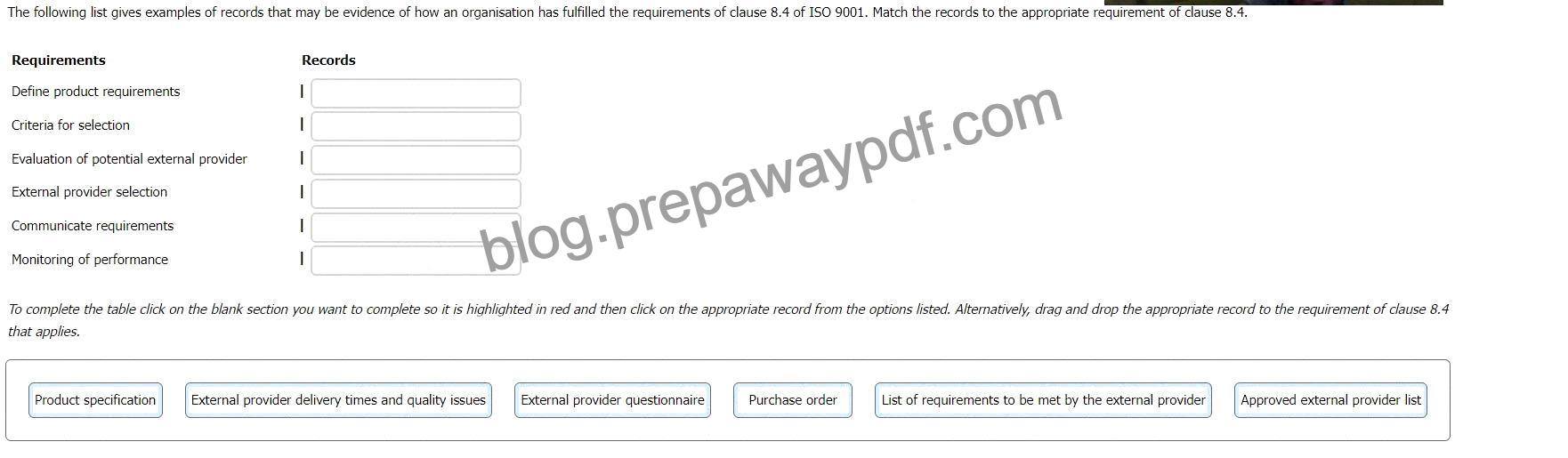
Q32. The following list gives examples of records that may be evidence of how an organisation has fulfilled the requirements of clause 8.4 of ISO 9001. Match the records to the appropriate requirement of clause 8.4.
Q33. You are carrying out an audit at a single-site organisation seeking certification to ISO 9001 for the first time.
The organization manufactures cosmetics for major retailers and the name of the retailer supplied appears on the product packaging. Sales turnover has increased significantly over the past five years.
You are interviewing the new Product Development Manager. You note that a software application called SWIFT is used to help control the product development process.
You have gathered audit evidence as outlined in the table. Match the ISO 9001 clause 8.3 extracts to the audit evidence.

Q34. Scenario 7: POLKA is a car manufacturing company based in Stockholm, Sweden. The company has around 14,000 employees working in different sectors which help with the design, painting, assembling, and test drives of the final product. The company is widely known for its qualitative products and affordable prices. In order to retain their reputation, POLKA implemented a quality management system (QMS) based on ISO 9001.
Before applying for certification, the company decided to conduct an internal audit to check whether there are any nonconformities in their QMS and if the requirements of ISO 9001 are being fulfilled.
The top management appointed Sean, the internal auditor, as the team leader of the internal audit team. Sean required from the top management to have unrestricted access to the employees and executives of POLKA and to the documented information. Furthermore, Sean required to establish a team with a large number of auditors, considering the size and the complexity of the organization. The top management of POLKA agreed with Sean’s requirements.
The top management, in cooperation with Sean, assigned 10 more employees to the audit team.
Following that. Sean planned the audit activities and assigned the roles and responsibilities to each auditor. They began by interviewing employees of different manufacturing departments to check whether they are aware of the process of the QMS implementation. While conducting these activities, one of the auditors asked Sean for permission to audit the department in which he worked on a daily basis, as he was very familiar with the processes of the department.
Along the way, the teams findings showed that the staff were trained, documented information was updated, and the QMS fulfilled the requirements of ISO 9001. The internal audit took three weeks to complete, and on the last week the audit team held a final meeting The team shared their results and together drafted the audit report This report was submitted to the top management of the company. The report was maintained as documented information, and was available to the relevant interested parties.
Based on the scenario above, answer the following question:
Scenario 7 states that Sean planned audit activities on his own. Is this acceptable?


Q35. Scenario 4:
TD Advertising is a print management company based in Chicago. The company offers design services, digital printing, storage, and distribution. As TD expanded, its management recognized that success depended on adopting new technologies and improving quality.
To ensure customer satisfaction and quality improvement, the company decided to pursue ISO 9001 certification.
After implementing the QMS, TD hired a well-known certification body for an audit. Anne Key was appointed as the audit team leader. She received a document listing the audit team members, audit scope, criteria, duration, and audit engagement limits.
Anne reviewed the document and approved the audit mandate. The certification body and TD’s top management signed the certification agreement.
Before contacting TD, Anne reviewed the audit scope and noticed that TD made changes to it due to the adoption of new printing equipment. However, Anne disagreed with the changes, stating they would affect the audit timeline. She considered withdrawing from the audit.
The audit team members were selected based on their knowledge of the legal and other regulations that TD is subject to. Is this acceptable?


Q36. Scenario 7: POLKA is a car manufacturing company based in Stockholm, Sweden. The company has around
14,000 employees working in different sectors which help with the design, painting, assembling, and test drives of the final product. The company is widely known for its qualitative products and affordable prices. In order to retain their reputation, POLKA implemented a quality management system (QMS) based on ISO
9001.
Before applying for certification, the company decided to conduct an internal audit to check whether there are any nonconformities in their QMS and if the requirements of ISO 9001 are being fulfilled. The top management appointed Sean, the internal auditor, as the team leader of the internal audit team. Sean required from the top management to have unrestricted access to the employees and executives of POLKA and to the documented information. Furthermore, Sean required to establish a team with a large number of auditors, considering the size and the complexity of the organization. The top management of POLKA agreed with Sean’s requirements.
The top management, in cooperation with Sean, assigned 10 more employees to the audit team. Following that. Sean planned the audit activities and assigned the roles and responsibilities to each auditor. They began by interviewing employees of different manufacturing departments to check whether they are aware of the process of the QMS implementation. While conducting these activities, one of the auditors asked Sean for permission to audit the department in which he worked on a daily basis, as he was very familiar with the processes of the department.
Along the way, the teams findings showed that the staff were trained, documented information was updated, and the QMS fulfilled the requirements of ISO 9001. The internal audit took three weeks to complete, and on the last week the audit team held a final meeting The team shared their results and together drafted the audit report This report was submitted to the top management of the company. The report was maintained as documented information, and was available to the relevant interested parties.
Based on the scenario above, answer the following question:
According to Scenario 7, one of the auditors requested permission from Sean to audit the department in which he worked on a daily basis. Should Sean grant the auditor permission?


PECB ISO-9001-Lead-Auditor Exam Syllabus Topics:

Topic Details
Topic 1
  • Closing an ISO 9001 audit: The topic focuses on concluding a QMS audit and conducting audit follow-up activities.
Topic 2
  • Fundamental audit concepts and principles: Questions about interpreting and applying the main concepts and principles related to a QMS audit appear in this topic.
Topic 3
  • Managing an ISO 9001 audit program: This topic evaluates your abilities to establish and managing a QMS audit program.
Topic 4
  • Conducting an ISO 9001 audit: It evaluates your skills to conduct a QMS audit.
Topic 5
  • Preparing an ISO 9001 audit: This topic covers sub-topics related to preparing a quality management system audit.


Get New ISO-9001-Lead-Auditor Certification Practice Test Questions Exam Dumps: https://www.prepawaypdf.com/PECB/ISO-9001-Lead-Auditor-practice-exam-dumps.html

Related Links: giphy.com myportal.utt.edu.tt www.slideshare.net myportal.utt.edu.tt app.parler.com scalar.usc.edu

Leave a Reply

Your email address will not be published. Required fields are marked *

Enter the text from the image below